Max Payne 2: The Fall of Max Payne — key art: black silhouettes of Max and Mona Sax in an embrace, each holding a pistol, on white

Max Payne 2: The Fall of Max Payne

Two years after the first game, Max is a New York cop again, and Mona Sax, the contract killer he took for dead, is back in his life. Remedy’s 2003 sequel tells it as a film noir love story.

The story

Two years later, the same city

The setup and the cast — the ending is left for further down

Max has been acquitted of the charges that hung over him after the first game, and he is a detective with the NYPD again — his connections to the Inner Circle, a secret society, got him the badge back. He still has nightmares about the past. Max tells the story in flashback, and the first one puts him in a hospital bed, recovering from a bullet, before the game rewinds a few more nights.

It starts with a shootout at a warehouse that belongs to Vladimir Lem, a Russian mobster and Max’s friend, where a gang of hitmen called the Cleaners has come for the guns. There Max runs into Mona Sax, the contract killer he believed had died two years earlier. From that night the trail runs through Vinnie Gognitti, now underboss of the Punchinello family, and Max’s colleague Valerie Winterson, all the way up to Senator Alfred Woden, the head of the Inner Circle.
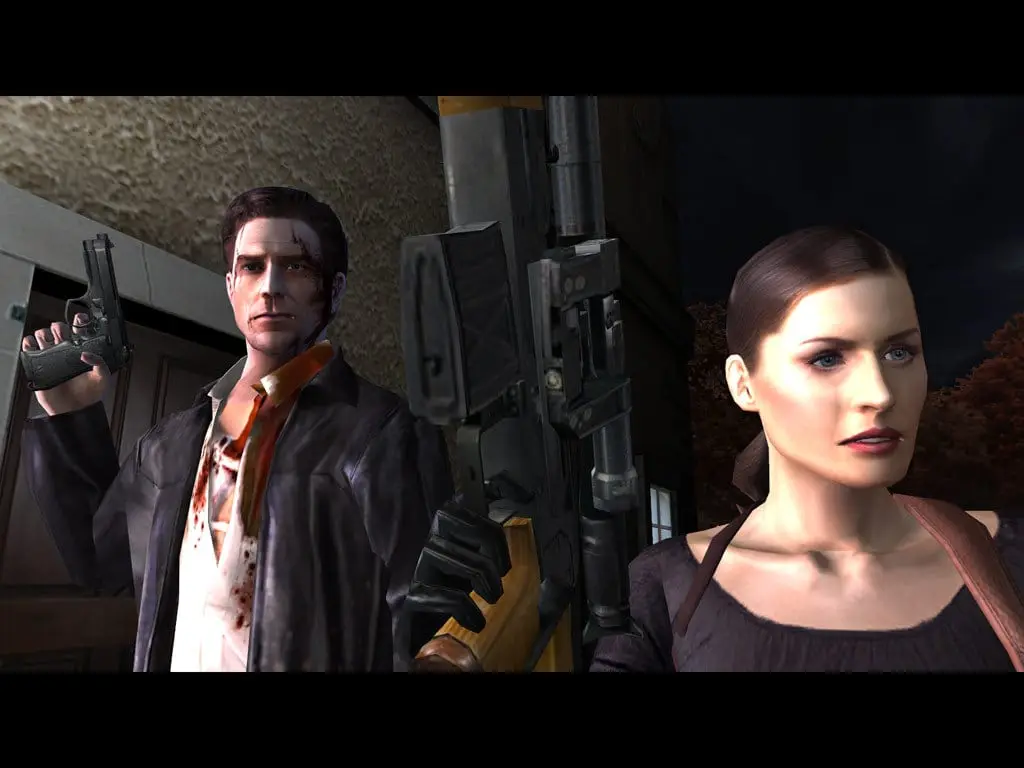
Max Payne 2: The Fall of Max Payne — Max and Mona Sax side by side, both armed

The writing

A film noir love story

Sam Lake’s script for the sequel

Sam Lake, who wrote the first game and gave Max his face in it, wrote this one as well and decided on a film noir love story, which he felt suited Max better than anything else. The first game had drawn on Norse mythology and hard-boiled detective novels; the sequel borrows from the doomed romances of noir cinema and puts Max and Mona at its center.

Lake’s plan for the sequel was to hold on to what had worked, repair what had not and then steer the plot somewhere players would not see coming. His script ended up three times the length of the first one, and he hoped the more tangled story would pay off on a second run. He also argued that the genre’s stock elements — a hostile city full of crime, heavy rain late at night, a cynical detective down on his luck — still carry a story a long way.

Gameplay

Three parts, two playable heroes

How the campaign is built and what it unlocks

The campaign is linear and split into three parts. Most of it puts you in Max’s shoes, but in several levels of parts two and three you play as Mona. You start with a 9mm pistol and work up to shotguns, submachine guns, assault rifles and sniper rifles, and a grenade or a Molotov cocktail now sits in its own secondary slot. Up close, either hero can pistol-whip an enemy.

Max’s inner monologue tells you what to do next. On a first playthrough there is only one difficulty, and it adjusts itself: die too often and the enemies get less sharp while painkillers turn up more often. Beating the game unlocks the harder settings and two modes — New York Minute, which scores each level by how quickly you clear it, and Dead Man Walking, five set pieces where you hold out as long as you can against enemies that keep respawning.

Bullet time

Bullet time, version 2.0

What changed in the slow motion

The slow motion is back: time crawls while your aim keeps full speed, and the picture turns sepia so you know it is running. A meter empties while you use it and fills back up on its own when you stop — or much faster if you kill enemies. A shootdodge, a dive in any direction you choose, slows time in mid-air and costs nothing from the meter.

Remedy called the new system version 2.0. Each kill in a streak slows time a little more and returns part of the meter, a change meant to get players diving into fights head-first instead of waiting behind cover. Reloading in bullet time now plays its own animation: Max ducks, spins to look around the room and holds still for a beat, which buys you a second to plan the next move.

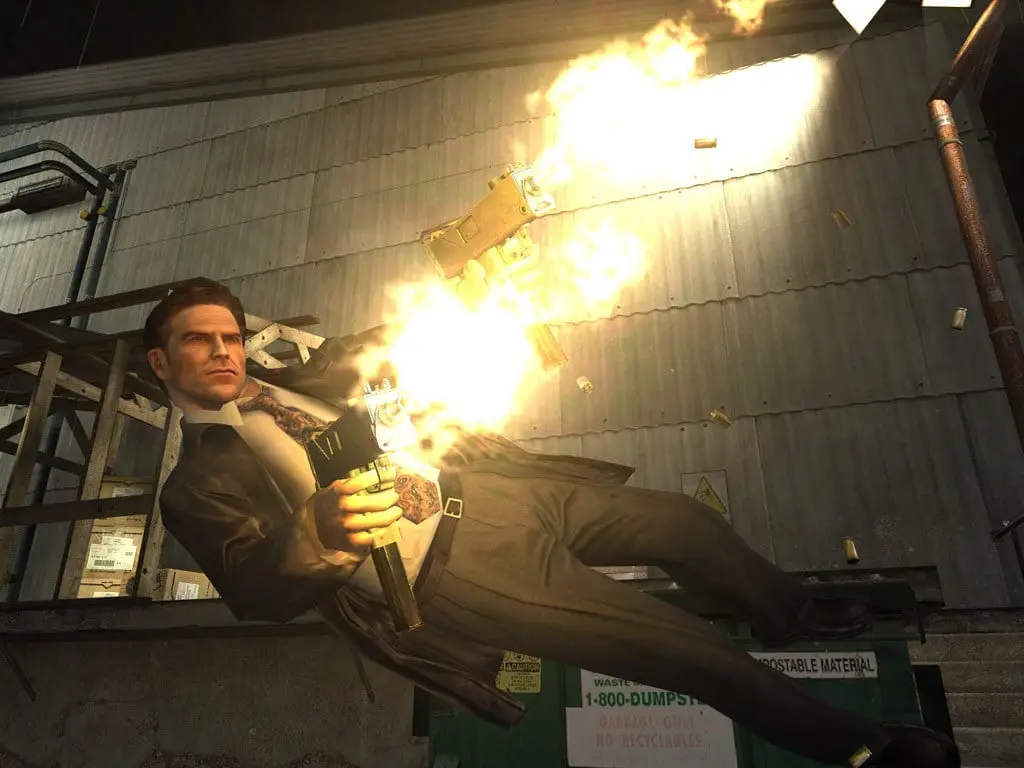
Max Payne 2: The Fall of Max Payne — Max dives past a warehouse wall firing a pistol, spent casings in the air

Engine

Havok physics and toppling cover

The technology behind the firefights

Max Payne 2 runs on an upgraded version of the first game’s engine with the Havok physics engine added on top — the developers said it was plainly the best fit for what they needed. Crates you crouch behind tip over when enemy fire hits them, a grenade thrown next to a wall can send an enemy’s cover flying, and bodies land convincingly after an explosion. Weapons, bombs and Molotovs were tuned to behave more naturally, and their sound was redone to match.

Max’s lucid dreams, where the whole picture turns hazy and loses focus, are the scene the developers pointed to when they talked about the effects. The game’s renderer works through DirectX 8.1, yet ghosting, shader effects, reflections and refraction are pushed far enough that it looks like DirectX 9 work. Characters have more polygons than before, so their outlines look smoother, and far more facial expressions: in the first game Max had just one, here he smirks and raises his eyebrows.

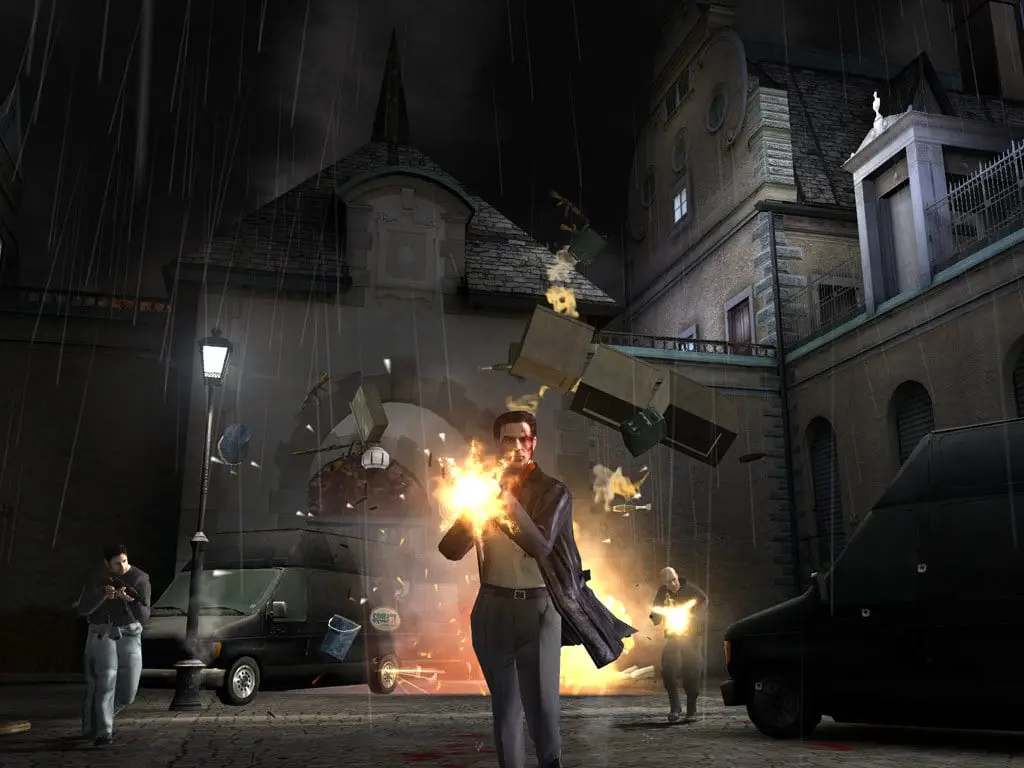
Max Payne 2: The Fall of Max Payne — Max fires a pistol on a rainy night street beside a street lamp, debris flying from an explosion

Cast

A new face, the same voice

Who plays whom, and how the story is shown

Max looks different: the first game modeled him on Sam Lake, the sequel on the actor Timothy Gibbs. James McCaffrey voices Max again, and the Academy of Interactive Arts & Sciences nominated him for its award for outstanding male character performance. Also in the cast: Wendy Hoopes as Mona, Jonathan Davis as Vlad, Fred Berman as Vinnie, John Braden as Senator Woden and Jennifer Server as Winterson.

Comic-book panels with voice-over still frame the story, though more scenes than before play out in the engine. The developers kept the panels on purpose: they cost less than full animation and worked better, they could be reshuffled whenever the plot changed during development, and they leave part of each scene to the player’s imagination.

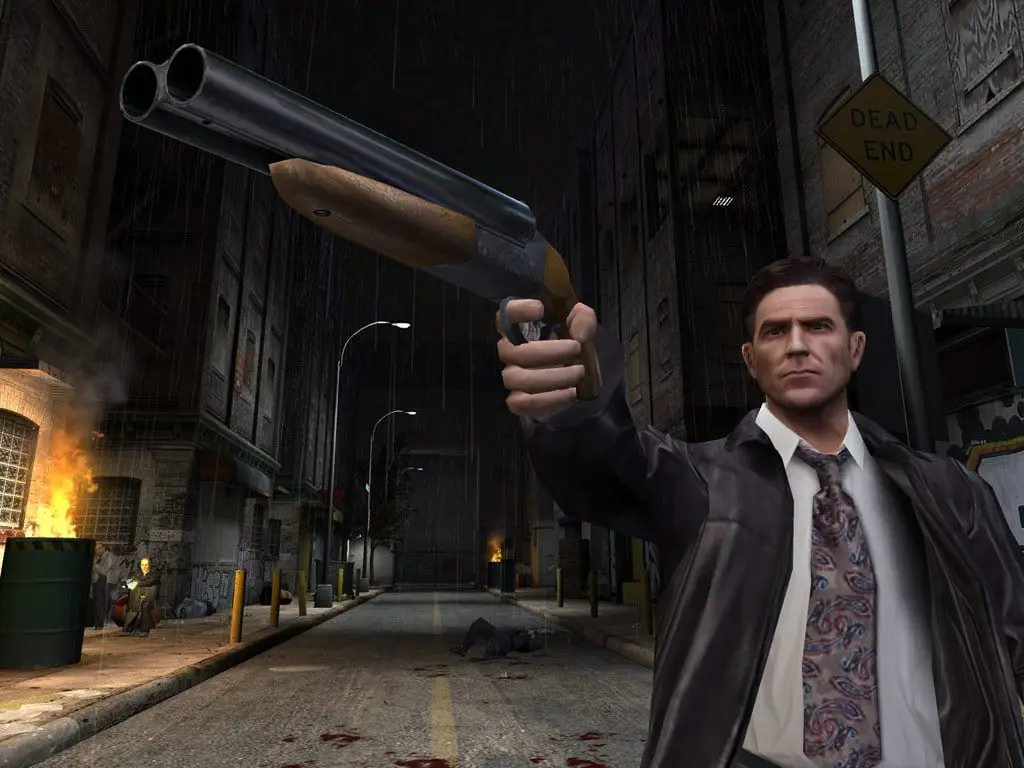
Max Payne 2: The Fall of Max Payne — Max raises a sawed-off shotgun in a night alley under a Dead End sign, fires burning behind him

Music

Late Goodbye

The score and the song

Kärtsy Hatakka and Kimmo Kajasto came back for the score, with cello played by Perttu Kivilaakso of Apocalyptica. The end credits roll over Late Goodbye by Poets of the Fall, a song whose lyrics grew out of a poem by Sam Lake.

Late Goodbye was the band’s first single. It climbed to number 14 on the Finnish singles chart and to number 1 on Radio Suomipop’s Top 30, and inside the game you hear it again and again, sung or hummed by the characters.

Spoilers

How it ends — both ways

Skip this row if you have not finished the game

Woden tells Max that the Cleaners answer to Vlad, who wants the Inner Circle and the city’s underworld for himself; Winterson turns out to have been Vlad’s lover and helper. Vlad kills Vinnie, shoots Max and reveals that Mona has been working for Woden — and that it was Woden who sent the Valhalla file to the district attorney’s office, the file Max’s wife stumbled on before his family was killed.

At Woden’s mansion Mona turns on Max to carry out her orders and cannot go through with it; Vlad shoots her and kills Woden, and Max kills Vlad as the house burns around them. In the standard ending Mona dies in Max’s arms as the police arrive. Finish the game on the highest difficulty and you get the other ending, in which Mona lives and the two of them kiss.

Release

October 2003 on PC

The deal, the date and the modding tools

Take-Two bought the Max Payne series from Remedy and 3D Realms on December 5, 2001, paying $10 million plus 970,000 shares of stock, and said in the same announcement that a sequel was coming. In May 2002 it agreed to pay the two companies up to $8 million more in incentives for making it, and in September 2003 it set the date: October 15.

Max Payne 2: The Fall of Max Payne came out on Windows on October 15, 2003 (October 24 in Europe). Rockstar and Remedy also put out development tools, so players could build mods with new weapons, moves, camera views, places and characters.

PS2 and Xbox

The console versions

Xbox on November 25, 2003, PS2 on December 2 (both December 5 in Europe)

Remedy made the game itself; Rockstar Vienna handled the Xbox and PlayStation 2 ports, which came out within seven weeks of the PC version. Metacritic rates the Xbox version 84 and the PS2 one 73 — the only one of the three to land in mixed territory.

A New Zealand Herald reviewer praised the Xbox port for looking close to the PC game, but found the PS2 version only “an okay job”, noticeably rougher on the eye and outclassed by the stronger machines.

Reviews

Critics loved it, and wanted more of it

Metacritic — PC 86, Xbox 84, PS2 73

Reviews were warm: Metacritic puts the PC version at 86. IGN scored the PC game 9.4 and GameSpot 9.0. Critics praised the action and the story, and the main complaint was that it ends too soon.

IGN’s Tom McNamara felt the noir setting gave Max and Mona’s story real weight, though some lines struck him as hammy. The Sunday Times was the harshest, with 2 out of 5 and a verdict that the story was cheesy.

The Toronto Sun’s Steve Tilley called the lifelike physics the game’s best feature but wished it were less linear, and the Sydney Morning Herald’s Dan Toose, who also found the campaign short, felt the harder settings and the extra modes give it replay value. 1UP’s complaint was different: the final boss fight, it said, is a weak close to an otherwise excellent game.

It collected several awards: Outstanding Art Direction at the 2004 Golden Satellite Awards, Editors’ Choice picks at GamePro, IGN, GameSpy and GameSpot, and a Game of the Month title from Game Informer. At the 7th Interactive Achievement Awards it was nominated five times, Game of the Year among them.

Sales

A hit with critics, a miss in stores

What Take-Two said about it

Good reviews did not turn into sales. In early 2004 Take-Two named the “continued disappointing sales” of Max Payne 2 as one reason it cut its forecast for the year, and by June 2005 the game had sold only 950,000 copies in the US. After it, Remedy went on to Alan Wake, and the series waited nearly a decade for Max Payne 3.

Length

About six hours

HowLongToBeat, September 2026

As of September 2026, HowLongToBeat puts the main story at about 6 hours, with extras at about 7½ and everything at about 9½ — shorter than the first game; reviewers in 2003 already complained that it ends too soon. For a second run there are the unlockable difficulty levels and the two extra modes.

Today

Where to play it today

Official stores only, as of September 2026

On PC, the game has been on Steam since January 4, 2008, published by Rockstar Games. As of September 2026 about 94 percent of its roughly 14,700 Steam reviews are positive. On Steam Deck, Valve rates it Playable: the default controls work, though the game sometimes shows keyboard or other controller icons and does not switch to an external pad by itself.

On Xbox, as of September 2026, the store lists Max Payne 2 for Xbox One and Xbox Series X|S — the whole trilogy has been backward compatible there since November 15, 2021 — rated Mature 17+ for intense violence, blood, sexual themes and strong language.

Getting the PC version to start can take some work. A player guide from around 2017 says the Steam copies of the first two games would not start on Windows 7 and later. Its fix: Windows 98/ME compatibility mode on the game’s executable (running it as administrator is recommended too), a game folder renamed without spaces, the matching installdir line in the game’s Steam app manifest changed to the new name, and a restart of Steam. As of September 2026, Steam’s community hub also lists player guides for a widescreen fix on Windows 10 and for startup problems on modern PCs.

The story is being told again

As of September 2026, Remedy is remaking this game together with the first one as a single title, headed for PlayStation 5, Xbox Series X|S and PC — with no release date yet.

What’s known about the remake